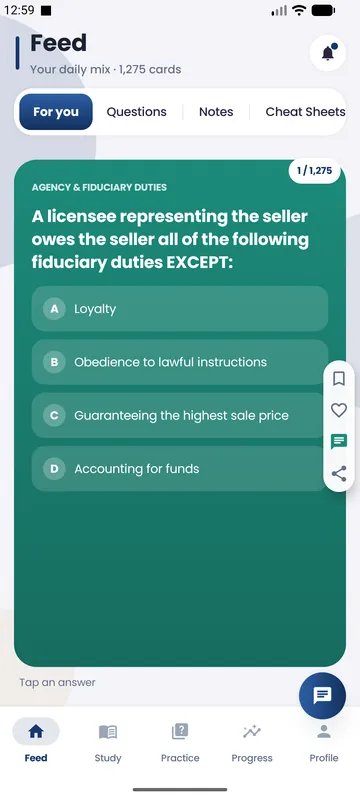
Before you read
Test yourself first: 5 questions
Question 1 of 5
Which records must a Georgia broker retain to comply with GREC record-keeping requirements?
Answer: B. Georgia brokers must retain records of their real estate transactions and trust/escrow accounts (contracts, disbursements, deposits, agreements, etc.) for the period required by GREC. Relying solely on third parties does not satisfy the broker's duty.
Question 2 of 5
A Georgia salesperson is generally prohibited from doing which of the following?
Answer: A. A Georgia salesperson works under and is paid by the sponsoring broker; the salesperson may not accept compensation directly from a party to the transaction.
Question 3 of 5
Under Georgia's Brokerage Relationships in Real Estate Transactions Act (BRRETA), when must a broker disclose to a prospective client the agency relationships the firm offers and the firm's brokerage relationship policy?
Answer: B. BRRETA requires the broker to disclose the nature of available agency relationships and the firm's policy on dual agency before the client enters into a brokerage engagement and before the broker obtains confidential information, so the consumer can make an informed choice about representation.
Question 4 of 5
A federal disclosure that applies to most Georgia homes built before 1978 and must be given to buyers regardless of Georgia's caveat emptor doctrine is the:
Answer: A. The federal Residential Lead-Based Paint Hazard Reduction Act requires sellers of most housing built before 1978 to disclose known lead-based paint hazards and provide an EPA pamphlet, regardless of state caveat emptor principles. This applies to Georgia transactions involving pre-1978 dwellings.
Question 5 of 5
Under Georgia license law, where must a broker deposit earnest money received in connection with a real estate transaction?
Answer: B. Georgia requires brokers to hold money belonging to others (such as earnest money) in a designated trust or escrow account that is kept separate from the broker's own personal and business funds. Mixing such money with the broker's funds is commingling and is prohibited.
Keep the streak going with more questions like these, each with a full rationale.
What you need to know
Earnest money and other client funds tied to a contract must be placed in the broker's trust/escrow account and handled according to the contract terms and GREC rules, without commingling. Because Georgia is not a community-property state, marital ownership and signature requirements follow common-law title rules rather than community-property assumptions. When a dispute arises over escrowed funds, the broker must follow the contract and the Commission's trust-account procedures rather than releasing funds unilaterally.
Georgia Contract & Transaction Specifics: FAQs
Is Georgia Contract & Transaction Specifics on the real estate exam?
Yes. State License Law is a scored domain on the Georgia real estate licensing exam, and this topic appears in the state license-law portion.
Is this cheat sheet free?
Yes — every page on Cinna RE's resource library is free to read, print and share. The app adds practice questions, mock exams and a readiness score.
Does Georgia test this differently?
Georgia applies its own license law on top of the national portion. This page covers the Georgia rules specifically, which is what the state section of your exam tests.