A licensee must provide the mandatory licensee-consumer relationship disclosure at the first personal meeting to discuss a specific property.
Before you read
Test yourself first: 5 questions
Question 1 of 5
Which agency is responsible for licensing and regulating real estate salespersons and brokers in Massachusetts?
Answer: B. In Massachusetts, real estate licensees are regulated by the Board of Registration of Real Estate Brokers and Salespersons, which operates under the Division of Occupational Licensure (DOL). A private trade association such as the Association of Realtors does not issue or regulate licenses.
Question 2 of 5
The Massachusetts Board of Registration of Real Estate Brokers and Salespersons is best described as:
Answer: B. The Board is a state regulatory body composed of appointed members. It administers the licensing law, adopts regulations, and oversees licensee conduct. It is neither a private association, a federal agency, nor a court of law.
Question 3 of 5
In Massachusetts, which agency has the authority to investigate complaints against real estate licensees and to suspend or revoke a license for violations of the license law?
Answer: B. The Board of Registration of Real Estate Brokers and Salespersons, within the Division of Occupational Licensure, regulates licensees and has authority to investigate complaints and impose discipline, including suspension or revocation. Trade associations and the Registry of Deeds have no licensing-discipline power.
Question 4 of 5
Which of the following actions by a Massachusetts licensee would most likely be grounds for disciplinary action by the Board?
Answer: A. Substantial misrepresentation is a classic license-law violation subject to discipline. Recommending inspections, providing the mandatory agency disclosure, and keeping deposits in a separate escrow account are all proper, required, or recommended practices.
Question 5 of 5
The Massachusetts mandatory agency disclosure form is best described as which of the following?
Answer: D. The Massachusetts mandatory disclosure is an informational notice, not a contract. It explains the agency relationships available (seller's agent, buyer's agent, facilitator, dual or designated agent) so the consumer understands whom the licensee works for. It does not create a binding representation agreement by itself.
Keep the streak going with more questions like these, each with a full rationale.
Must-know rules
- Massachusetts recognizes seller's agent, buyer's agent, designated agency, dual agency, and facilitator (non-agent) roles.
- A licensee must provide the mandatory licensee-consumer relationship disclosure at the first personal meeting to discuss a specific property.
- The relationship disclosure form is informational and is not itself a contract creating agency.
- Dual agency is permitted only with the informed written consent of both buyer and seller.
- Designated agency lets a broker assign different agents within the firm to represent each side, with written consent.
- A facilitator (transaction broker) assists both parties without representing either and owes limited statutory duties.
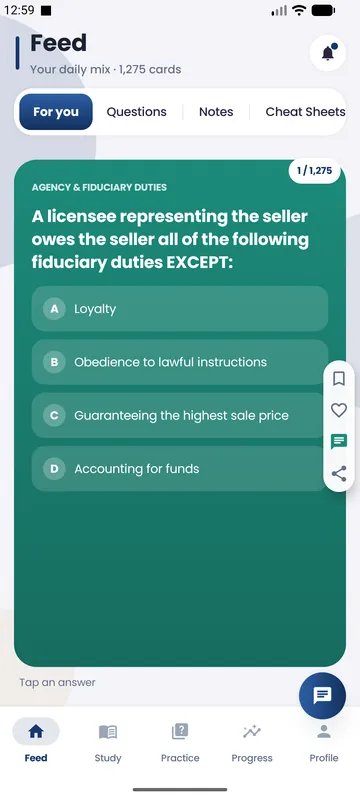
- Agents owe clients duties of loyalty, confidentiality, disclosure, obedience, reasonable care, and accounting.
Massachusetts Agency Model Quick Reference: FAQs
Is Massachusetts Agency Model Quick Reference on the real estate exam?
Yes. State License Law is a scored domain on the Massachusetts real estate licensing exam, and this topic appears in the state license-law portion.
Is this cheat sheet free?
Yes — every page on Cinna RE's resource library is free to read, print and share. The app adds practice questions, mock exams and a readiness score.
Does Massachusetts test this differently?
Massachusetts applies its own license law on top of the national portion. This page covers the Massachusetts rules specifically, which is what the state section of your exam tests.