Before you read
Test yourself first: 5 questions
Question 1 of 5
In a typical Massachusetts residential transaction, the parties commonly sign a brief initial agreement followed later by a more comprehensive contract. The more detailed, binding document that governs the transaction terms is usually the:
Answer: B. Massachusetts practice commonly involves an initial Offer to Purchase, followed by a more detailed Purchase and Sale Agreement (P&S) that sets out the full terms governing the deal. The P&S is the comprehensive binding contract between buyer and seller, distinct from the listing agreement or lender's commitment.
Question 2 of 5
In Massachusetts, a real estate salesperson may lawfully accept compensation for a brokerage transaction:
Answer: B. A Massachusetts salesperson may be paid only by their sponsoring/supervising broker, not directly by buyers, sellers, or other parties. This reinforces the broker's responsibility for supervising the salesperson's activity.
Question 3 of 5
A Massachusetts broker is responsible for the brokerage activities of the salespersons affiliated with the firm. This means the broker must:
Answer: B. In Massachusetts, the supervising broker is responsible for overseeing affiliated salespersons and can be held accountable for their conduct in brokerage transactions. The broker's supervisory duty is central to the license law structure.
Question 4 of 5
A Massachusetts licensee who assists a buyer and seller in a transaction but does not represent either party as a client is acting as a:
Answer: C. Massachusetts recognizes the role of facilitator (sometimes called a non-agent or transaction broker). A facilitator helps the parties complete the transaction and owes duties of honesty, accounting, and reasonable care, but does not owe the fiduciary loyalty of a client relationship to either side.
Question 5 of 5
Which limitation applies to a dual agent in a Massachusetts transaction?
Answer: D. A dual agent cannot fully represent the interests of both parties, so the agent's duties are limited. The dual agent must not disclose confidential information, including either party's motivation or willingness to accept a different price, without that party's consent. The agent stays neutral on negotiating points.
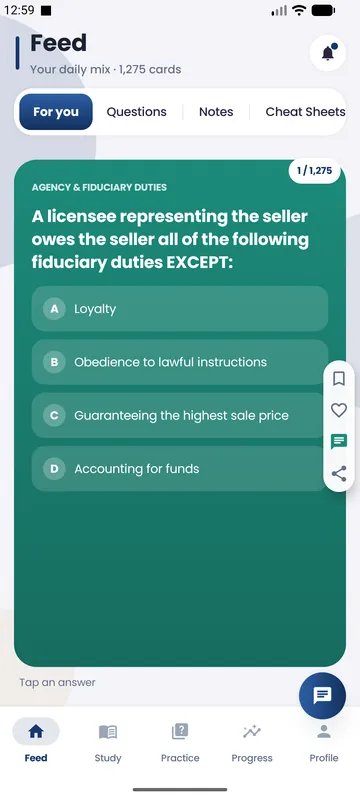
Keep the streak going with more questions like these, each with a full rationale.
What you need to know
Property condition follows a caveat emptor approach, so the buyer bears responsibility for investigating, but the licensee may not actively misrepresent or conceal known material defects. Mandatory disclosures include the licensee-consumer relationship disclosure at the first personal meeting and federal and state lead paint notification for pre-1978 housing. Because Massachusetts is not a community property state, ownership and the division of marital property are determined under common-law and equitable principles.
Massachusetts Contract/Transaction Specifics: FAQs
Is Massachusetts Contract/Transaction Specifics on the real estate exam?
Yes. State License Law is a scored domain on the Massachusetts real estate licensing exam, and this topic appears in the state license-law portion.
Is this cheat sheet free?
Yes — every page on Cinna RE's resource library is free to read, print and share. The app adds practice questions, mock exams and a readiness score.
Does Massachusetts test this differently?
Massachusetts applies its own license law on top of the national portion. This page covers the Massachusetts rules specifically, which is what the state section of your exam tests.