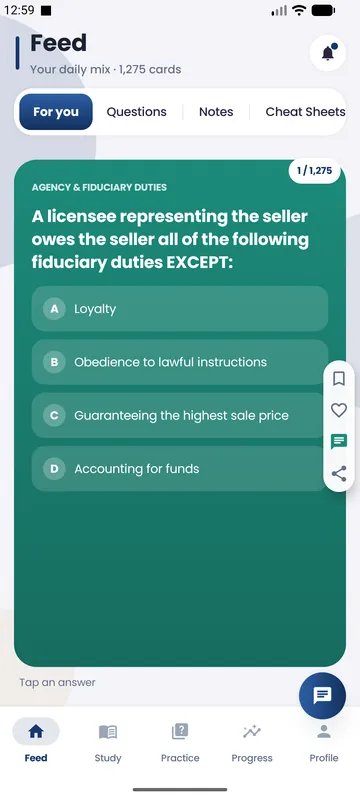
Client/escrow money must be held in a separate trust/escrow account — never commingled with the broker's funds.
Before you read
Test yourself first: 5 questions
Question 1 of 5
How long must a New York broker generally retain records of real estate transactions, including escrow and trust account records?
Answer: A. New York requires brokers to keep records of each transaction—including agency disclosures, deposits, and escrow account activity—for at least 3 years and to make them available to the Department of State upon request.
Question 2 of 5
Which of the following actions by a New York licensee would most likely be grounds for disciplinary action by the Department of State?
Answer: C. Commingling client trust funds with the broker's own funds violates New York's escrow handling rules and is grounds for discipline; the other actions are proper practice.
Question 3 of 5
A broker deposits a client's earnest money into the broker's personal operating account and uses part of it to pay office rent. This conduct is known as:
Answer: A. Mixing client funds with the broker's own funds is commingling, and spending those funds is conversion. Both are serious violations; client deposits must be kept in a separate escrow/trust account.
Question 4 of 5
In New York, money a broker receives that belongs to another party (such as an earnest-money deposit) must be held in what type of account?
Answer: B. New York law requires a broker to deposit money belonging to others into a separate special escrow (trust) account, kept apart from the broker's own personal and business funds. Holding such money in a general operating account would be commingling.
Question 5 of 5
A New York broker takes an earnest-money deposit being held in escrow and uses it to pay the brokerage's office rent. This act is properly called:
Answer: B. Conversion is using funds entrusted to the broker for the broker's own purposes. It is more serious than commingling (merely mixing funds) and can result in license revocation and criminal liability.
Keep the streak going with more questions like these, each with a full rationale.
Must-know rules
- Sellers of residential 1-4 unit homes deliver a Property Condition Disclosure Statement (PCDS).
- Client/escrow money must be held in a separate trust/escrow account — never commingled with the broker's funds.
- Pre-license education: 77 hours; license term: 2 years.
- NY is NOT a community property state — it is an equitable distribution state.
- Agency disclosure is due at first substantive contact.
- Lead-based paint disclosure applies to housing built before 1978 (federal rule).
- Brokers must maintain records and may be audited by the DOS.
NY Disclosures, Escrow/Trust Funds & Key Numbers Cheat Sheet: FAQs
Is NY Disclosures, Escrow/Trust Funds & Key Numbers Cheat Sheet on the real estate exam?
Yes. State License Law is a scored domain on the New York real estate licensing exam, and this topic appears in the state license-law portion.
Is this cheat sheet free?
Yes — every page on Cinna RE's resource library is free to read, print and share. The app adds practice questions, mock exams and a readiness score.
Does New York test this differently?
New York applies its own license law on top of the national portion. This page covers the New York rules specifically, which is what the state section of your exam tests.