Before you read
Test yourself first: 5 questions
Question 1 of 5
For each two-year renewal cycle after the first, how many hours of continuing education must a Florida licensee complete?
Answer: D. After completing post-licensing education, Florida licensees must complete 14 hours of continuing education (including required core law and ethics content) each two-year renewal cycle.
Question 2 of 5
A Florida sales associate has held the license through one full renewal cycle. How many hours of continuing education are required for each subsequent renewal period (after the post-license requirement is satisfied)?
Answer: B. Once the 45-hour post-license requirement has been met, Florida licensees must complete 14 hours of FREC-approved continuing education each subsequent two-year renewal cycle.
Question 3 of 5
If a Florida sales associate lets the license expire by failing to renew and complete CE, the license status during the first period after expiration is best described as:
Answer: B. When a Florida license expires for failure to renew, it generally becomes involuntarily inactive. The licensee may not practice but can reactivate by completing the required education and paying applicable fees within the allowed period before it becomes null and void.
Question 4 of 5
Under Johnson v. Davis, a Florida seller/licensee must:
Answer: B. Johnson v. Davis established that a seller (and licensee) must disclose known facts materially affecting the value of residential property that are not readily observable to the buyer.
Question 5 of 5
A Florida licensee currently acts as a single agent for a seller but now wishes to also work with a buyer-customer on the same property as a transaction broker. What must occur to make this change properly?
Answer: C. To transition from single agent to transaction broker, Florida requires the principal to give written consent by signing the 'Consent to Transition to Transaction Broker' notice BEFORE the change in relationship occurs. This protects the principal who originally bargained for full single-agent representation.
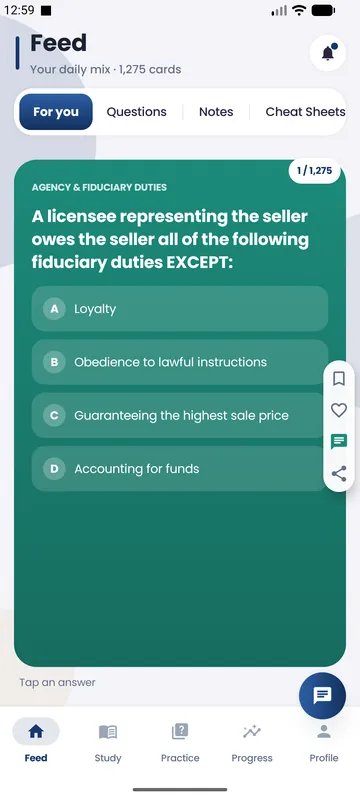
Keep the streak going with more questions like these, each with a full rationale.
What you need to know
Davis, sellers and their licensees must disclose any facts materially affecting the value of residential property that are not readily observable to the buyer. This duty to disclose known latent material defects applies regardless of the brokerage relationship, so even a transaction broker cannot conceal a known problem such as a leaking roof or active termite infestation. Florida is not a community property state, which affects how marital property and title are handled in a transaction.
Required Florida Seller and Licensee Disclosures: FAQs
Is Required Florida Seller and Licensee Disclosures on the real estate exam?
Yes. State License Law is a scored domain on the Florida real estate licensing exam, and this topic appears in the state license-law portion.
Is this cheat sheet free?
Yes — every page on Cinna RE's resource library is free to read, print and share. The app adds practice questions, mock exams and a readiness score.
Does Florida test this differently?
Florida applies its own license law on top of the national portion. This page covers the Florida rules specifically, which is what the state section of your exam tests.