
Before you start: the exam is two exams
Almost every state splits the licensing exam into a national portion and a state portion. They are scored separately, and in most states you must pass both. This matters more than any study technique: a candidate who scores 90% nationally and 60% on state law still fails. Plan your month around both halves from day one.
Week 1 — build the vocabulary
The first week is about not being confused by the wording. Real-estate exams test definitions relentlessly: estates, encumbrances, agency relationships, types of deeds. Get these solid and every later topic becomes easier to reason about.
- Property ownership, estates and ways to hold title
- Encumbrances — liens versus non-money limits like easements
- Government powers (police power, eminent domain, taxation, escheat)
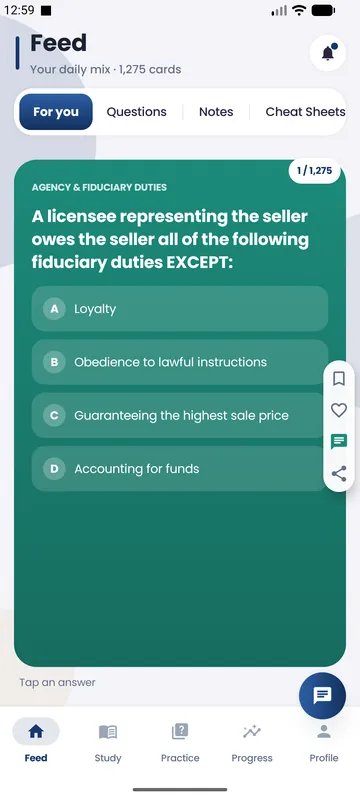
- Agency relationships and who owes duties to whom
Do 20–30 questions a day and read the explanation for every one you get wrong — including the ones you guessed correctly. A right answer for the wrong reason will not repeat itself on exam day.

Week 2 — contracts, financing and valuation
This is the heaviest content week. Contracts and financing together make up a large share of the national portion, and they are where careless reading costs marks.
- Contract formation, contingencies, breach and remedies
- Listing agreements and buyer representation agreements
- Loan programs — conventional, FHA, VA, USDA — and who qualifies
- The note versus the mortgage or deed of trust, and what each one does
- Sales comparison approach, cost approach, income approach
Week 3 — math, disclosures and fair housing
Math frightens people more than it should. There are perhaps eight formulas, and most questions are one formula applied once. Work them by hand until the setup is automatic — commission splits, prorations, loan-to-value, transfer taxes, area calculations.
Fair housing and disclosure duties are pure recall, and they are among the most reliably tested topics on the exam. Learn the protected classes and the exemptions precisely.
Week 4 — your state, then simulate
Spend the first half of the final week almost entirely on your state's license law: the commission or department that regulates licensees, licensing and continuing-education requirements, agency disclosure rules, trust and escrow account handling, advertising rules, and the penalties for violations. This is the part no national question bank prepares you for, and it is the most common reason for a retake.
Then simulate. Sit at least two full-length, timed 100-question exams in the last few days — same length, same conditions, no pausing. You are training stamina and pacing as much as knowledge.
How to know you're actually ready
Raw accuracy is a bad signal, because it hides your weakest area. A useful readiness read weights your worst category heavily, counts every topic — including the ones you have never opened — and scores the national and state portions separately. If your readiness estimate cannot tell you which of the two halves is weaker, it is not telling you much.
Practically: you are ready when you can sit a full mock cold, score comfortably above your state's passing mark, and have no category you have been quietly avoiding.
The most common way this plan fails
Skipping state law until the last two days. It feels safe because national content is where all the study material is — but the state portion is shorter, which means each question is worth more, and it is entirely memorisation you cannot reason your way through.