Before you read
Test yourself first: 5 questions
Question 1 of 5
In North Carolina, a written agency agreement with a SELLER must be in place:
Answer: B. North Carolina requires that a listing (seller) agency agreement be in writing from its inception. Unlike buyer agency, seller representation may not begin orally. The written agreement must be signed before or at the time the broker begins marketing the property.
Question 2 of 5
A North Carolina broker is working with an unrepresented buyer who calls about a listing the broker's firm has. In this first-contact situation, what must the broker disclose?
Answer: B. A broker who represents the seller must disclose that representation to a prospective buyer at first substantial contact, so the buyer understands the broker is not protecting the buyer's interests and should not share confidential bargaining information. The agency relationship is not created merely by the buyer calling.
Question 3 of 5
A provisional broker discovers material structural defects in a property but, at the seller's request, conceals them from prospective buyers. Under North Carolina license law, this conduct is best described as:
Answer: B. North Carolina prohibits both willful misrepresentation and willful omission (concealment) of material facts. A broker may not hide known material defects even at a client's direction; the duty of honesty and fair dealing to all parties overrides a client's improper instruction. This is a disciplinable license-law violation, not merely a private civil matter.
Question 4 of 5
Regardless of any 'No Representation' answers on the disclosure form, a North Carolina broker still has which duty to a buyer?
Answer: B. A seller's 'No Representation' choice limits the seller's disclosure duty, but it does not relieve the broker. NC brokers must not misrepresent property and must disclose material facts they know or reasonably should know about, such as a known structural defect, to all parties.
Question 5 of 5
On North Carolina's Residential Property and Owners' Association Disclosure Statement, a seller is permitted to respond to most condition questions with which set of choices?
Answer: B. The NC disclosure statement lets a seller answer most questions 'Yes,' 'No,' or 'No Representation.' Choosing 'No Representation' means the seller is not making a representation about that item, and the seller has no duty to disclose that condition even if known, shifting investigation to the buyer.
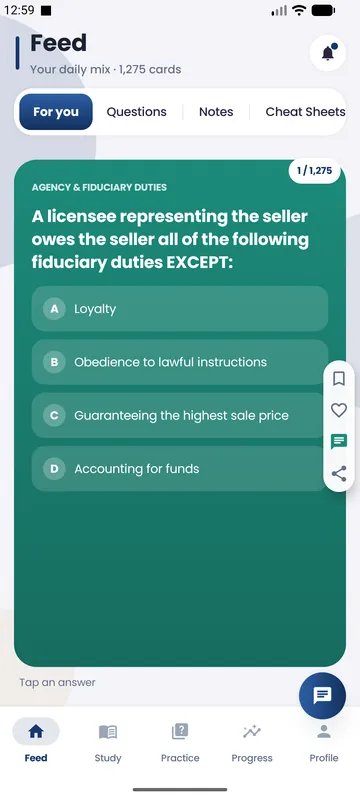
Keep the streak going with more questions like these, each with a full rationale.
What you need to know
A broker may represent the seller, the buyer, or, with informed written consent, act as a dual or designated agent. The disclosure helps consumers understand whom the agent represents before they share confidential information.
North Carolina's Agency and Representation Model: FAQs
Is North Carolina's Agency and Representation Model on the real estate exam?
Yes. State License Law is a scored domain on the North Carolina real estate licensing exam, and this topic appears in the state license-law portion.
Is this cheat sheet free?
Yes — every page on Cinna RE's resource library is free to read, print and share. The app adds practice questions, mock exams and a readiness score.
Does North Carolina test this differently?
North Carolina applies its own license law on top of the national portion. This page covers the North Carolina rules specifically, which is what the state section of your exam tests.